You've finished the manuscript. You've rewritten the opening lines, middle section, and ending more times than you can remember. Now what?
For most authors, the answer is getting your manuscript reviewed by a professional editor. But where do you find a great one? In this guide, we cover five of the best editing services on the market, including what they typically charge for different types of editing on an 80,000-word manuscript (the average novel length).
Here's a quick overview:
|
Service |
Best For |
Services |
Average Price (80K words) |
Turnaround |
|---|---|---|---|---|
|
Reedsy |
Hand-picking a vetted editor by genre, with built-in payment protections |
Editorial assessment, developmental editing, copyediting, proofreading |
Assessment: ~$2,000 Dev edit: ~$2,880 Copy: ~$2,160 Proof: ~$1,600 |
Negotiated per project; typically a few weeks to a few months |
|
Kirkus Editorial |
Structured editorial packages with top editors |
Basic copyediting, collaborative editing, professional editing package |
Copyedit: $1,600 Collab: $2,499 Pro package: $5,299 |
Copyedit: 15 days Collab: 20 days Pro package: custom |
|
BookBaby |
Predictable per-word pricing and a single vendor for editing + publishing |
Line editing, copyediting, proofreading |
Line: $3,200 Copy: $2,000 Proof: $1,200 |
2-4 weeks |
|
Scribendi |
Fast, centralized editing without managing a freelancer |
Book critique, book editing, book proofreading |
Critique: $919 Editing: ~$2,368 Proofing: ~$2,368 |
2 weeks |
|
ProofreadingPal |
A final proofread under a tight deadline, with one- or two-proofreader options |
Book proofreading and light copyediting |
1 proofreader: $1,440 2 proofreaders: $2,240 |
1 week |
The 5 Best Editing Services
1. Reedsy
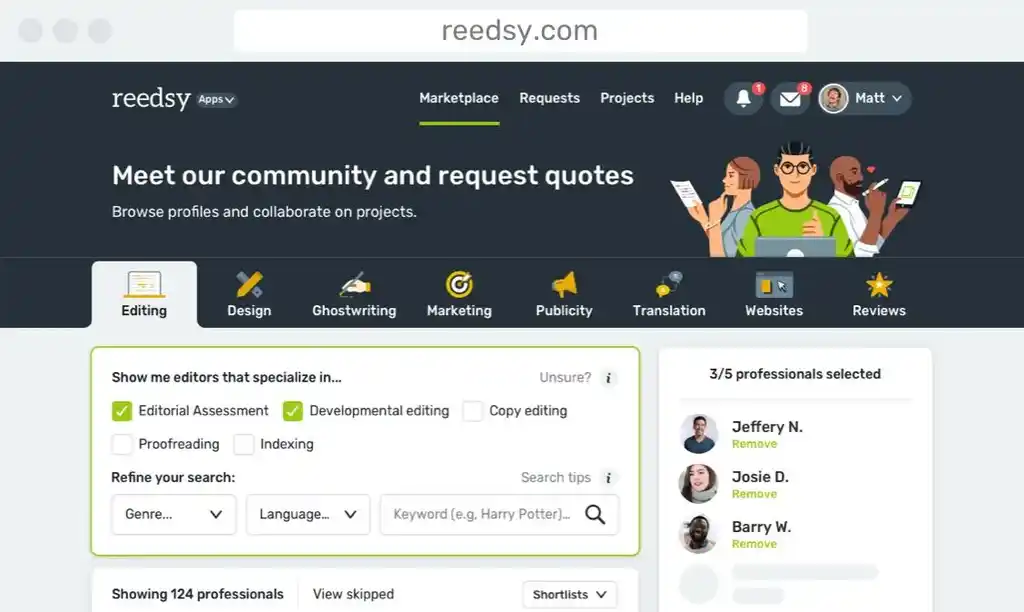
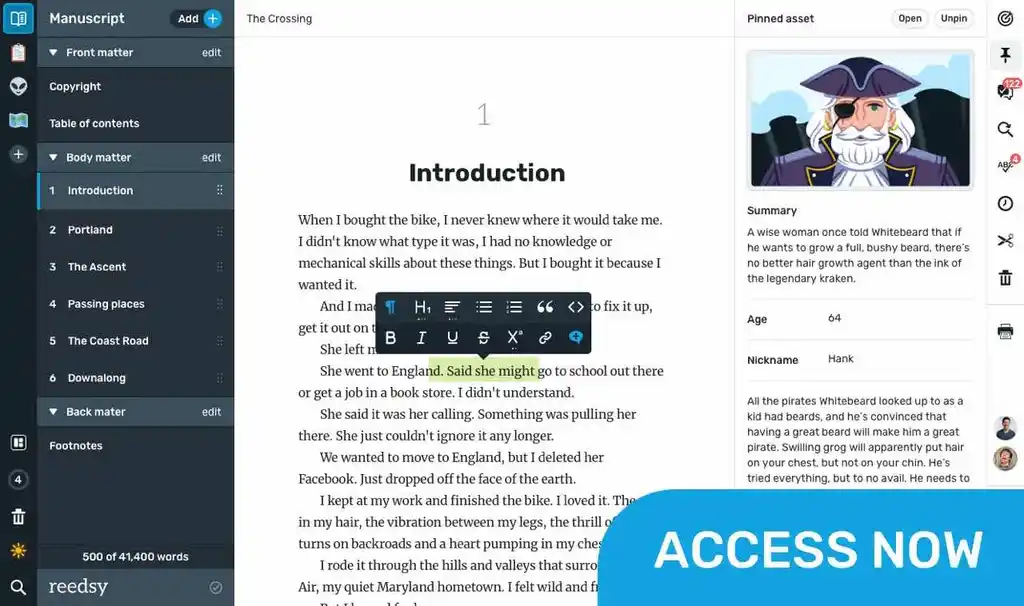
 Reedsy remains the strongest default choice for authors who want control over who edits their work. It's a curated marketplace where you browse top-tier editor profiles, request quotes, and manage the entire collaboration on-platform.
The editorial vetting is crucial: Reedsy requires at least three years of professional editing experience and experience working for a traditional publisher. The platform accepts only a small fraction of applicants (around 3%).
On Reedsy, you can hire editors for different purposes:
- Editorial Assessment (~$2,000 for 80K words) is a full manuscript overview of your manuscript’s strengths and weaknesses, delivered as an editorial letter of feedback (typically 2-5 pages).
- Developmental Editing (~$2,880 for 80K words) is the big-picture pass: structure, pacing, character arcs, argument flow. This is where an editor tells you that chapter seven doesn't earn its place or that your thesis needs to move to the introduction. It's the most expensive type of editing and the one most likely to change your manuscript substantially.
- Copyediting (~$2,160 for 80K words) works at the sentence level — tightening prose, improving clarity, adjusting tone, etc.
- Proofreading (~$1,600 for 80K words) is the final pass — typos, formatting errors, missed punctuation. It assumes the manuscript has already been edited.
Depending on budget, most authors hire a combination of them (usually developmental + copyediting). In terms of pricing, it will depend on the scope of your project and the rate of the freelancer you hire. Reedsy publishes transparent cost benchmarks drawn from thousands of real quotes.
You’ll be able to find a great editor within your budget — something that’s much harder to do on fixed-price platforms. Moreover, on Reedsy you build a relationship with your editor — something that, as we’ll discuss later, can be invaluable for your long-term author career.
Another thing that sets Reedsy apart is the infrastructure around the hire. Payments run through Stripe in an escrow-like structure with milestone-based releases. Messaging, file sharing (with Dropbox and Box integrations), and contracts all live on-platform. If something goes wrong, Reedsy offers dispute mediation through its Project Protection system — partial or full refunds are possible.
The tradeoff is that you might not get everything you want super fast. Your dream editor might be busy or too expensive, so you might need to wait, negotiate, or find someone else. Moreover, there are no options for languages other than English, so factor that into account if it matters to you.
2. Kirkus Editorial
 The brand Kirkus Reviews is one of the most recognized names in the book world, and their editorial service leans into that with stringent hiring requirements. Editors must have experience at a Big Five publisher (or equivalent) and must pass what Kirkus describes as a "rigorous battery of editing tests."
Kirkus offers three tiers:
- Basic Copyediting (~$1,600 for 80K words), which focuses on grammar, punctuation, spelling, etc. It’s for authors looking for a basic manuscript cleanup.
- Collaborative Editing (~$2,499 for 80K words), which consists of a developmental edit plus line editing and commentary throughout, with a detailed editorial letter and a one-hour consultation with your editor.
- The Professional Editing Package (~$5,299 for 80K words), which aims to mirror the editorial process of traditional publishing houses, bundling all three stages: a collaborative edit, a copyedit, and a final proofread.
All editing is delivered in Microsoft Word using tracked changes, so you can accept or reject each correction individually. After purchase and upload, Kirkus matches your manuscript to an editor within two business days. Standard turnaround is 15 business days for copyediting and 20 for collaborative editing, with extra time for manuscripts over 100,000 words. Expedited service is also available at checkout.
The trade-off boils down to creative control and cost. When you hire a freelancer, you have a direct relationship. With Kirkus, you work through a "Production Editor." While this ensures a standard of quality, some authors find the communication more formal and less personal than working one-on-one with a private editor.
Moreover, for many self-published authors, the thousands of dollars spent on a Kirkus edit might be better spent on a more affordable professional edit plus a robust marketing budget. A "Kirkus Edit" doesn't carry the same industry "seal" as a "Kirkus Review" does on a book cover.
3. BookBaby
 BookBaby's value proposition is integration. If you're planning to self-publish and want one company to handle editing, formatting, cover design, printing, and distribution, BookBaby packages all of that together. However, you can use BookBaby's editing services as a standalone option without printing your book through them. The pricing is transparent, and you can easily calculate your costs with their on-page calculator.
They also offer three tiers, with each tier building on the previous one.
- Proofreading (~$1,200 for 80K words) is the final-pass option to catch typographical errors, spelling errors, grammar issues, and other inconsistencies.
- Copyediting (~$2,000 for 80K words) goes deeper, working through your manuscript word by word to address grammar, word usage, punctuation, spelling, syntax, and consistency, all following the Chicago Manual of Style.
- Line Editing (~$3,200 for 80K words) is the most comprehensive option — it includes everything in copyediting plus a line-by-line pass to clear up confusing details, awkward phrasing, and weak word choices, along with editor's notes and overall comments on the manuscript.
The process is straightforward: you upload your manuscript, select your genre, and choose your service level. BookBaby matches it to a genre-specialized editor, and in 1–3 weeks (depending on service level and manuscript length), you receive two files — a "Markup" version with tracked changes you can accept or reject, and a "Final" version with all edits applied.
The trade-off is developmental editing. If your manuscript needs big-picture structural work before it's ready for line-level passes, you'll likely need to pair BookBaby with a separate developmental editor.
4. Scribendi
 Scribendi is an all-in-one editing platform — you submit your document, they assign an editor, and you get it back on a clearly stated timeline. The hiring pipeline claims only 5% of applicants are selected, and editors hold advanced degrees and are proficient with major style guides (though their individual profiles are not disclosed).
Scribendi is mostly aimed at scholars, with services like scientific editing and academic proofreading, but they have specific services for authors too. Specifically, they offer three options:
- Book Critique ($919 for 80K words) is the lightest option — you receive a 1–2 page evaluation covering plot, characterization, dialogue, structure, and coherence (for fiction) or thesis, organization, and prose clarity (for nonfiction), along with an assessment of your book's salability.
- Book Editing ($2,368 for 80K words) is the full treatment, combining developmental editing and copyediting in a single pass — your editor addresses big-picture structure and narrative flow while also refining language, style, and clarity throughout.
- Book Proofreading (~$2,368 for 80K words) is the final-pass option for manuscripts that have already been edited, covering spelling, grammar, typos, inconsistencies, and formatting of titles and headers, all delivered with tracked revisions and personalized proofreader notes.
Scribendi publishes turnaround options as fast as four hours for shorter documents, with timelines keyed to word count and service type. For an 80,000-word manuscript, expect about two weeks.
Scribendi also offers a bundle that combines book proofreading with a tailor-made query package, synopsis, and chapter-by-chapter outline — useful if you're preparing to pitch to agents.
The downside, like for the other platforms except for Reedsy, is less control. You don't choose your editor the way you would on a curated marketplace. Also, Scribendi's refund terms can be stricter — their terms state the company is not obligated to refund unless explicitly agreed.
While the platform excels at rapid turnaround and technical precision — making it a favorite for nonfiction and scholarly works — the lack of an introductory consultation or editor choice can feel impersonal for a novelist.
5. ProofreadingPal
 ProofreadingPal is a proofreading-focused service designed for manuscripts that are already written and edited but need a careful final polish. They go beyond the standard check for formatting, spelling, grammar, and punctuation — their proofreaders also offer suggestions on point of view, genre conventions, word usage, and sentence structure. Editors are native English speakers who've passed a comprehensive timed exam, and many hold master's or PhD degrees — you can actually see their names on the site.
What makes ProofreadingPal distinctive is the choice between one and two proofreaders. The two-proofreader model, where both independently review your document, is their signature offering and provides built-in redundancy for high-stakes work, such as a book going to print or a thesis defense scheduled in a week’s time.
That said, for longer manuscripts where budget matters more than double-checking, the one-proofreader option brings the cost down significantly. For an 80,000-word novel at a 7-day turnaround, a single proofreader runs $1,440, while having two proofreaders costs $2,240. Faster turnarounds are available (all the way down to 30 minutes for shorter documents), with pricing increasing accordingly.
The limitation, however, is scope: ProofreadingPal doesn't offer developmental or line editing. This is a proofreading and light copyediting operation, and that's what it does well.
How to choose
The truth is, you can only fully assess an editing service after you receive the edits. Turnaround times and pricing are easy to compare on paper, but what really matters at the end of the day is the quality of the feedback — and that's impossible to evaluate upfront.
Here's what most comparison guides won't tell you: editing is a relationship, not just a transaction. A great editor doesn't simply fix your prose. They teach you about the publishing process, challenge your assumptions about structure, and sometimes introduce you to other professionals you'll need along the way — an agent, a publicist, a cover designer. That mentorship compounds over time in ways that a quick-turnaround proofreading service never will.
This is why a marketplace like Reedsy tends to produce the best outcomes for authors. You're choosing a person, not a package. You can read their portfolio, see their genre specialization, and build a working relationship that lasts beyond a single manuscript.
That said, not every project calls for that level of investment. If you're editing flash fiction, for example, then Scribendi or ProofreadingPal might get the job done faster. Overall, the best editing service is the one that matches what your manuscript actually needs right now. Hopefully, this article will steer you in the right direction.