Every writer gets stuck from time to time — and poets are no exception. That’s why we’ve compiled 100 poem ideas to get your creative juices flowing.
These prompts are split across nine different categories, with examples from established poets to show these themes in action. So pick up a pen, select a category that speaks to you, and let's get writing.

Hire a poetry editor today.
The best are already on Reedsy, come meet them!
The inner self
Sometimes the best place to turn for inspiration is inwards. Here are some introspective poetry prompts to take you on a (self-guided) journey.
1. Write a poem addressed to your younger self.
2. Document a recurring dream or nightmare.
3. Write about something you've never told anyone.
4. Write about a lie you tell yourself.
5. Write about a quality you inherited that you wish you hadn't.
6. Write a dialogue between your head and your heart.
7. Explore what you do when no one is watching.
8. Write about a grudge you're still holding.
9. Write about a moment you felt completely at peace with yourself.
10. Write about a boundary you finally learned to set.
11. Write about a version of yourself you outgrew.
Example: Autopsychography by Fernando Pessoa
The poet is a man who feigns
And feigns so thoroughly, at last
He manages to feign as pain
The pain he really feels
Here, Fernando Pessoa reflects on how he transforms his emotion into poetry. His own internal pain is real, of course — but the version he presents to readers is compromised by that very transformation. Still, he’s talented enough that readers may not be able to tell the difference. It’s a nicely meta piece of commentary on poetry, personhood, and authenticity in one’s own creative work.
Personal relationships
Want to wax poetic about the good, the bad, or even the ugly in your personal relationships? Perhaps these prompts can inspire you to write about someone in your life.
12. Write about the first time someone broke your trust.
13. Write a poem to someone you've lost touch with.
14. Write about the moment you realized your parents were just people.
15. Write about someone you love but don't like.
16. Write about someone who mentored you without realizing it.
17. Write about a shared experience that bonded you to someone.
18. Write about a relationship that became toxic.
19. Write about a friendship that survived distance or time.
20. Write about learning to love someone's flaws.
21. Write about someone you misjudged.
Example: Those Winter Sundays by Robert Hayden
Sundays too my father got up early
and put his clothes on in the blueblack cold,
then with cracked hands that ached
from labor in the weekday weather made
banked fires blaze. No one ever thanked him.
Parent and child: a dynamic that transcends time, culture, and even species. Unfortunately, we are often unappreciative of our parents’ efforts until we reach adulthood ourselves, or in the worst case, until after they’re gone. This is the lens through which Robert Hayden examines the parent-child relationship, beautifully captured in this excerpt’s final line: “No one ever thanked him.”
Society & culture
For our third category, let’s zoom out even further. After all, the people immediately around us aren’t our only key influences — we're also shaped by the society we inhabit. Here are some poem ideas to help you explore culture and social structures.
22. A tradition you're expected to uphold but don't believe in.
23. Something normalized that shouldn't be normal.
24. How we measure success.
25. The illusion of choice.
26. The pace of modern life.
27. The death of third spaces.
28. The way we consume art.
29. How we talk about aging.
30. The glorification of being busy.
31. The cost of staying connected.
32. Small acts of everyday resistance.
33. The language we use to avoid saying what we mean.
Example: England in 1819 by Percy Bysshe Shelley
An old, mad, blind, despised, and dying King;
Princes, the dregs of their dull race, who flow
Through public scorn,—mud from a muddy spring;
Rulers who neither see nor feel nor know,
But leechlike to their fainting country cling
Till they drop, blind in blood, without a blow.
Poetry is widely considered an interpretive art form. Meaning is not fixed, but rather open to each reader's interpretation.
That is emphatically not the case in this example. Written during a period of major economic hardship, England in 1819 is a pointed indictment of the country’s “leechlike” aristocracy. Shelley leaves little room for ambiguity — his anti-establishment message rings loud and clear.
The natural world
If you’d like to be the next in a long line of poets that draw from the majesty of Mother Nature, here are some environmental prompts to be inspired by.
34. The first frost of the year.
35. What the ocean sounds like.
36. A flower growing through concrete.
37. A body of water you return to.
38. A plant you've tended.
39. A specific kind of weather that changes your mood.
40. How nature reclaims abandoned places.
41. The sound of cicadas at night.
42. Desert landscapes and what survives there.
43. Animal tracks in mud or snow.
44. A coral reef (living or dying).
45. The rings inside a tree stump.
46. A snake shedding its skin.
47. A bear leaving hibernation.
48. A bird building a nest.
49. Fog rolling in.
Example: Furu ike ya by Matsuo Bashō
An old silent pond
A frog jumps into the pond —
Splash! Silence again.
Furu ike ya is more than a simple aesthetic appreciation for the antics of amphibians (though that would be a perfectly valid reading as well). There's so much meaning packed into these three lines... Is it an ode to the fleeting nature of stillness? Or perhaps it’s a musing on humanity’s insignificance in the grand scheme of things. Regardless of how you choose to interpret this haiku, one thing is certain: the natural world is an exemplary muse with which to explore profundity in poetry.
Exploration & adventure
Ready to take your poetry somewhere new? Whether you're writing about distant destinations or unexpected detours, these exploration and adventure prompts will help you capture that spirit of discovery.
50. The moment you stepped off a plane into unfamiliar air.
51. The view from a train window.
52. Getting lost in a city.
53. The smell of a place you'll never forget.
54. A place you thought you'd love but didn't.
55. A journey you took alone.
56. The airport at 3AM.
57. Someone you met once and never again.
58. An unexpected detour that became the best part of a trip.
59. Getting sick far from home.
60. Navigating public transport in a foreign country.
61. A hitchhiking experience.
62. Sleeping in an unfamiliar bed.
63. Returning to a place you once called home.
Example: The Rime of the Ancient Mariner by Samuel Taylor Coleridge
The fair breeze blew, the white foam flew,
The furrow followed free;
We were the first that ever burst
Into that silent sea.
Few poems capture the spirit of exploration quite like The Rime of the Ancient Mariner, which recounts the tale of a sailor's cursed voyage after killing an albatross. As a ballad, The Rime of the Ancient Mariner is written to be sung or recited aloud, hence the melodic flow and tight rhyme scheme. The full poem is a true literary epic, clocking in at a staggering 143 stanzas. Your poem doesn’t need to be quite so lengthy, but you can certainly seek to capture the same spirit of discovery in just a few stanzas.
Everyday objects
As exciting as an international escapade may be, make no mistake: there is beauty to be found in all things. So, try studying your surroundings for something to write about. If you prefer to keep your home clutter free, then worry not — we’ve compiled a list of everyday objects here so that you, too, can be inspired by the ordinary.
64. An item you can never leave the house without.
65. The dishes piling up in your sink.
66. A photograph you've kept on display.
67. A book you've never finished.
68. An item you inherited from a family member.
69. A piece of jewelry you always wear.
70. A streetlight that's burned out.
71. A receipt you saved.
72. A fortune from a fortune cookie.
73. A password you've used for years.
74. A mirror you avoid looking into.
Example: Fork by Charles Simic
This strange thing must have crept
Right out of hell.
It resembles a bird’s foot
Worn around the cannibal’s neck.
Taking an everyday object and examining it from a different angle can make for surprisingly vivid poetry. This is exactly what Charles Simic does in Fork, comparing the titular kitchen utensil to a bird’s crooked foot. It presents an interesting creative challenge: how can you make the familiar seem strange? Perhaps you can pen a sister poem titled Spoon.
Sensory experiences
Between sight, sound, smell, taste, and touch, there’s no shortage of potential poetic inspiration when it comes to sensory experience. So gaze upon these sensational prompts, and use them as a springboard for your own poetry.
75. Seeing your reflection in an unexpected surface.
76. A fading afterimage when you close your eyes.
77. The sound of your name in someone else's accent.
78. The sound of a beating heart.
79. The smell of cut grass.
80. The smell of a particular season.
81. The taste of blood in your mouth.
82. The taste of something you haven't had since childhood.
83. The feeling of stubble or facial hair.
84. The feeling of vertigo or dizziness.
Example: The Fish by Elizabeth Bishop
… Here and there
his brown skin hung in strips
like ancient wallpaper,
and its pattern of darker brown
was like wallpaper:
shapes like full-blown roses
stained and lost through age.
To write a poem rife with sensory language, one can aim to engage multiple senses at once, or hone in on one specific sense to paint a detailed portrait. Elizabeth Bishop opts for the latter in The Fish, wherein she catalogs every visual detail of a caught fish’s appearance. Sometimes restriction breeds creativity, after all; narrowing your scope to a singular sense or subject can help you craft more vivid, focused imagery.
The passage of time
When it comes to writing poetry, there’s no time like the present. That’s why we’ve chosen the passage of time itself for our penultimate category. Spur your imagination with one of these time-honored poetry ideas.
85. A place that no longer exists.
86. Watching a child grow taller than you.
87. The moment you realized you're older than you feel.
88. The changing definition of "old."
89. The last time you did something for the last time.
90. A song that marks a specific year.
91. How grief changes over time.
92. How your vocabulary has changed.
93. Becoming the age someone was when you were young.
94. The year you stopped doing something without noticing.
95. A tradition that's dying out.
Example: Do not go gentle into that good night by Dylan Thomas
Do not go gentle into that good night,
Old age should burn and rave at close of day;
Rage, rage against the dying of the light.
Mortality is perhaps the ultimate marker of time's passage, and few poems address it as brazenly as Do not go gentle into that good night by Dylan Thomas. In it, the speaker pleads with his dying father to resist the inevitable: “Rage, rage against the dying of the light.”
Of course, not all time-focused poetry need be so somber. You may choose to focus on the sweet nostalgia of youth, or happy memories of a loved one who has since passed on.
Poetic form & structure
If you’re still struggling to start a poem after those ninety-five prompts, perhaps it isn’t a topic you’re searching for, but a format. Like any art form, there’s no one-size-fits-all poetic form. On the contrary, there are countless structures available that an enterprising poet can use to pen a powerful verse.
96. Sonnet – A 14-line poem with a specific rhyme scheme, traditionally written in iambic pentameter. Example: England in 1819 by Percy Bysshe Shelley.
97. Haiku – A traditional Japanese form of three lines with a 5-7-5 syllable pattern. Example: Furu ike ya by Matsuo Bashō.
98. Ballad – A narrative poem, often with a musical quality, told in quatrains (four-line stanzas) with a regular rhyme scheme. Example: The Rime of the Ancient Mariner by Samuel Taylor Coleridge.
99. Villanelle – a 19-line rhyming poem with some lines repeated, ending in a quatrain. Example: Do not go gentle into that good night by Dylan Thomas.
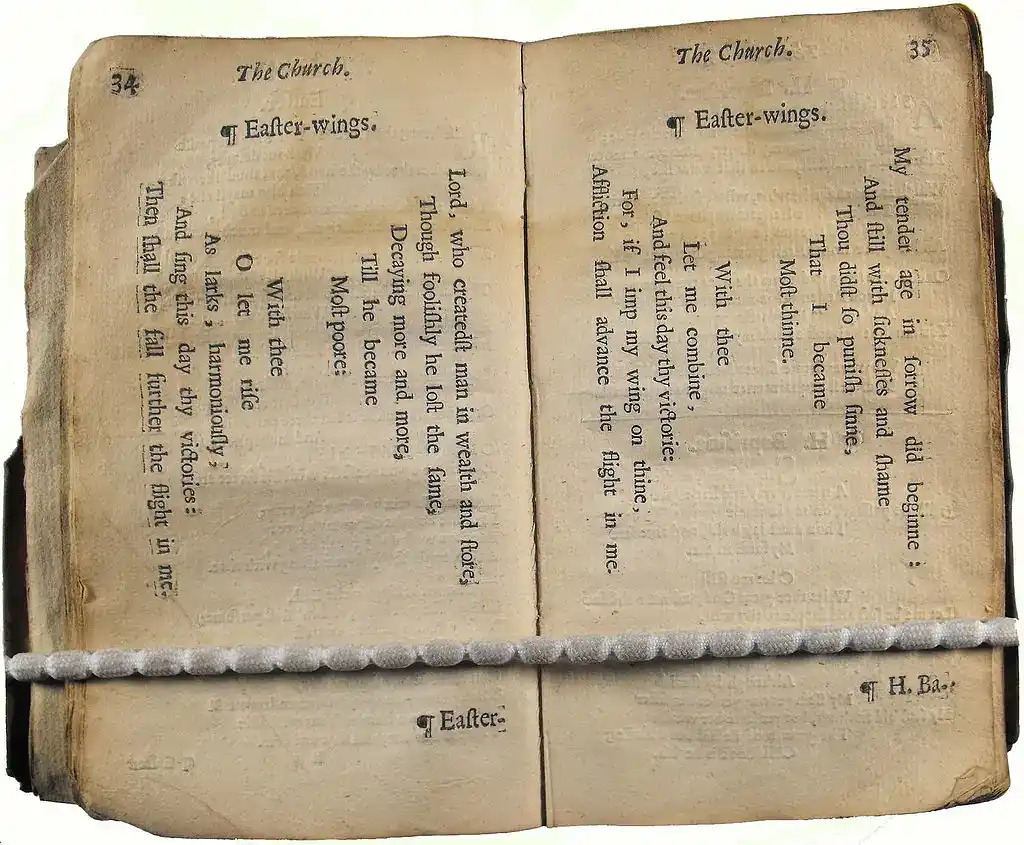
100. Concrete poetry – A poem where the visual arrangement of words on the page creates a shape or image related to the poem's meaning. Example: Easter Wings by George Herbert, pictured below.
The hardest part of writing is often just getting started. With these 100 prompts in your back pocket, all that's left is to choose one and put pen to paper. Good luck!